The Best Tres Leches Cake Recipe (Authentic, Moist, Make-Ahead)
If you have never made tres leches cake before, you are about to understand why 700 million people across Latin America consider it one of the great desserts of the world.
The premise sounds strange at first. You bake a light sponge cake, poke hundreds of holes in it while it is still warm, then pour a mixture of three milks over the top and refrigerate it for hours. The cake absorbs every drop. What comes out of the refrigerator the next morning is something that should by all logic be a soggy mess but is instead one of the most satisfying desserts you will ever eat: cold, creamy, barely holding its shape, tasting somewhere between a soft vanilla pudding and a very good cake, with none of the heaviness you would expect from something this saturated with dairy.
This is the recipe that gets all three of those details right: the sponge structure, the milk ratio, and the timing.
Why You’ll Love This Tres Leches Cake
- Genuinely authentic flavor. Three specific milks (sweetened condensed, evaporated, and heavy cream) each contribute something distinct to the final texture and taste, and the ratios in this recipe are calibrated to deliver all three.
- The best make-ahead cake you will ever bake. This cake must be made at least 4 hours ahead and is actually better the next day. For entertaining, that is not a compromise. That is the plan.
- Light sponge, not a dense crumb. The secret is whipped egg whites folded into the batter, which creates a structure open enough to absorb the milk mixture without collapsing into paste.
- No butter in the batter. The traditional recipe contains no butter. The fat comes entirely from the three milks and the whipped cream topping, which is what makes the sponge so absorbent.
- Feeds a crowd effortlessly. Made in a 9×13-inch pan, this recipe serves 12 to 15 people with no layering, leveling, or stacking required.
- Adaptable to any occasion. Cinco de Mayo, birthday celebrations, potlucks, summer dinners, or any gathering where you need a dessert that will genuinely impress without requiring significant last-minute work.
A Brief Origin Worth Knowing
Tres leches cake has one of the most debated origin stories in Latin American food. The claim is spread across at least four countries: Mexico, Nicaragua, Cuba, and Costa Rica all assert some version of ownership over the recipe’s invention.
The most widely accepted theory among food historians is that the recipe developed in Nicaragua and Mexico during the mid-twentieth century, possibly influenced by recipe cards printed on evaporated and condensed milk cans by Nestle and Carnation, both of which distributed these products widely across Latin America in the 1940s and 1950s. According to Tasting Table’s deep dive into tres leches origins the main contestants for the cake’s birthplace are Mexico and Nicaragua, with precursor soaked-cake desserts documented in both countries predating the modern version. The milk manufacturers had a commercial incentive to publish recipes using their products, and a sponge cake soaked in all three dairy products from one’s pantry was an ideal vehicle.
Whatever its exact origin, this cake became one of the defining desserts of the Latin American table and, from the 1990s onward, one of the most popular cakes in the United States as well. It is now firmly established as a birthday cake tradition across the American Southwest and in Mexican-American communities nationwide.
What You Need
For the Sponge Cake
- 1 cup all-purpose flour
- 1 1/2 teaspoons baking powder
- 1/4 teaspoon salt
- 5 large eggs, separated, room temperature
- 1 cup granulated sugar, divided
- 1/3 cup whole milk, room temperature
- 1 teaspoon vanilla extract
For the Three-Milk Soak
- 1 can (14 oz) sweetened condensed milk
- 1 can (12 oz) evaporated milk
- 1 cup heavy whipping cream
- 1 teaspoon vanilla extract
For the Whipped Cream Topping
- 2 cups heavy whipping cream, cold
- 3 tablespoons powdered sugar
- 1 teaspoon vanilla extract
For Garnish
- Ground cinnamon, for dusting
- Fresh strawberries or maraschino cherries (optional)
Recommended Equipment
| Amount | Name | Notes |
|---|---|---|
| 1 | 9×13-inch baking pan | Metal preferred over glass for even baking |
| 1 | KitchenAid stand mixer or hand mixer | For egg whites and whipped cream |
| 1 | Large mixing bowl | For egg yolk batter |
| 1 | Rubber spatula | For folding egg whites |
| 1 | Cake tester or toothpick | For doneness check |
| 1 | Fork or skewer | For poking holes |
| 1 | Wire rack | For initial cooling |
| 1 | Offset spatula | For spreading whipped cream topping |
Step-by-Step Instructions
Step 1: Prepare the Pan
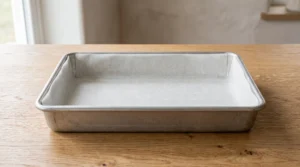
Preheat oven to 350 degrees F. Grease a 9×13-inch metal baking pan. Line the bottom with parchment paper and grease the parchment. Set aside.
Step 2: Mix the Dry Ingredients
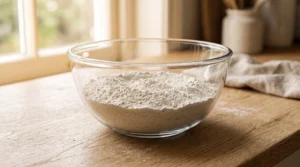
Whisk together the flour, baking powder, and salt in a bowl. Set aside.
Step 3: Make the Egg Yolk Batter
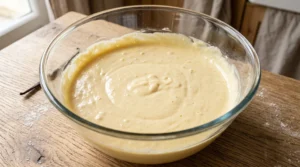
In a large bowl, beat the egg yolks with 3/4 cup of the granulated sugar on high speed for 3 to 4 minutes until the mixture is pale yellow, thick, and has roughly doubled in volume. Add the whole milk and vanilla extract. Whisk until combined. Gently fold the flour mixture into the egg yolk mixture with a rubber spatula until just combined.
Step 4: Whip and Fold the Egg Whites
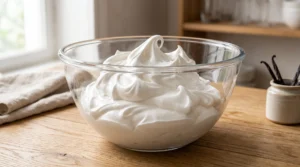
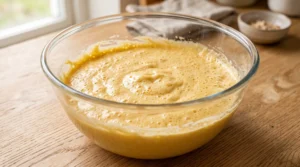
In a clean bowl with clean beaters, beat the egg whites on medium-high speed until soft peaks form. Gradually add the remaining 1/4 cup of sugar and continue beating until stiff, glossy peaks form. Fold the whipped egg whites into the batter in three additions, using a rubber spatula and a gentle folding motion. Stop folding as soon as no white streaks remain. Do not stir or deflate the whites. The batter should be light and slightly airy.
Step 5: Bake
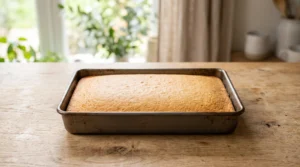
Spread the batter evenly into the prepared pan. Bake for 25 to 30 minutes until the top is golden, the edges are pulling away from the sides of the pan, and a cake tester inserted in the center comes out clean. The sponge will shrink slightly as it cools. This is normal and expected.
Step 6: Poke and Soak
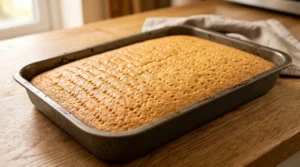
Remove the cake from the oven. While it is still warm, use a fork or skewer to poke holes all over the top surface of the cake, spacing them about half an inch apart. The more holes, the more surface area for the milk soak to penetrate.
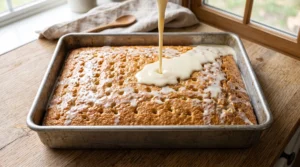
In a bowl or large measuring cup, whisk together the sweetened condensed milk, evaporated milk, heavy cream, and vanilla extract. Pour slowly and evenly over the warm, poked cake. The soak will pool initially, then absorb. Some liquid may pool around the edges of the pan. This is fine.
Step 7: Refrigerate
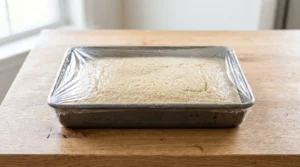
Cover the pan tightly with plastic wrap and refrigerate for at least 4 hours. Overnight is significantly better. The cake needs this time to absorb the milk mixture fully and for the flavors to meld. The difference between a 4-hour soak and an overnight one is noticeable in both texture and flavor.
Step 8: Top and Serve
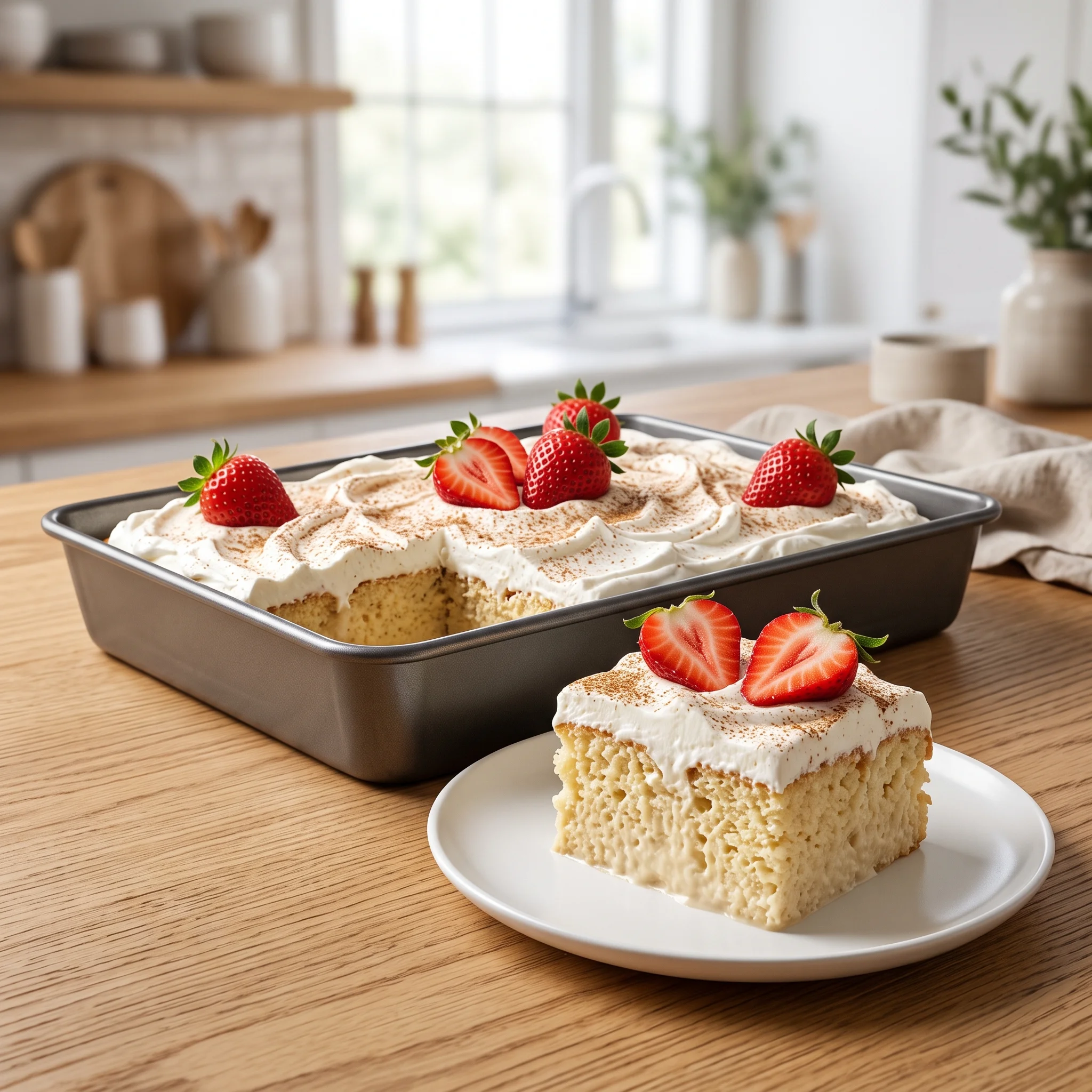
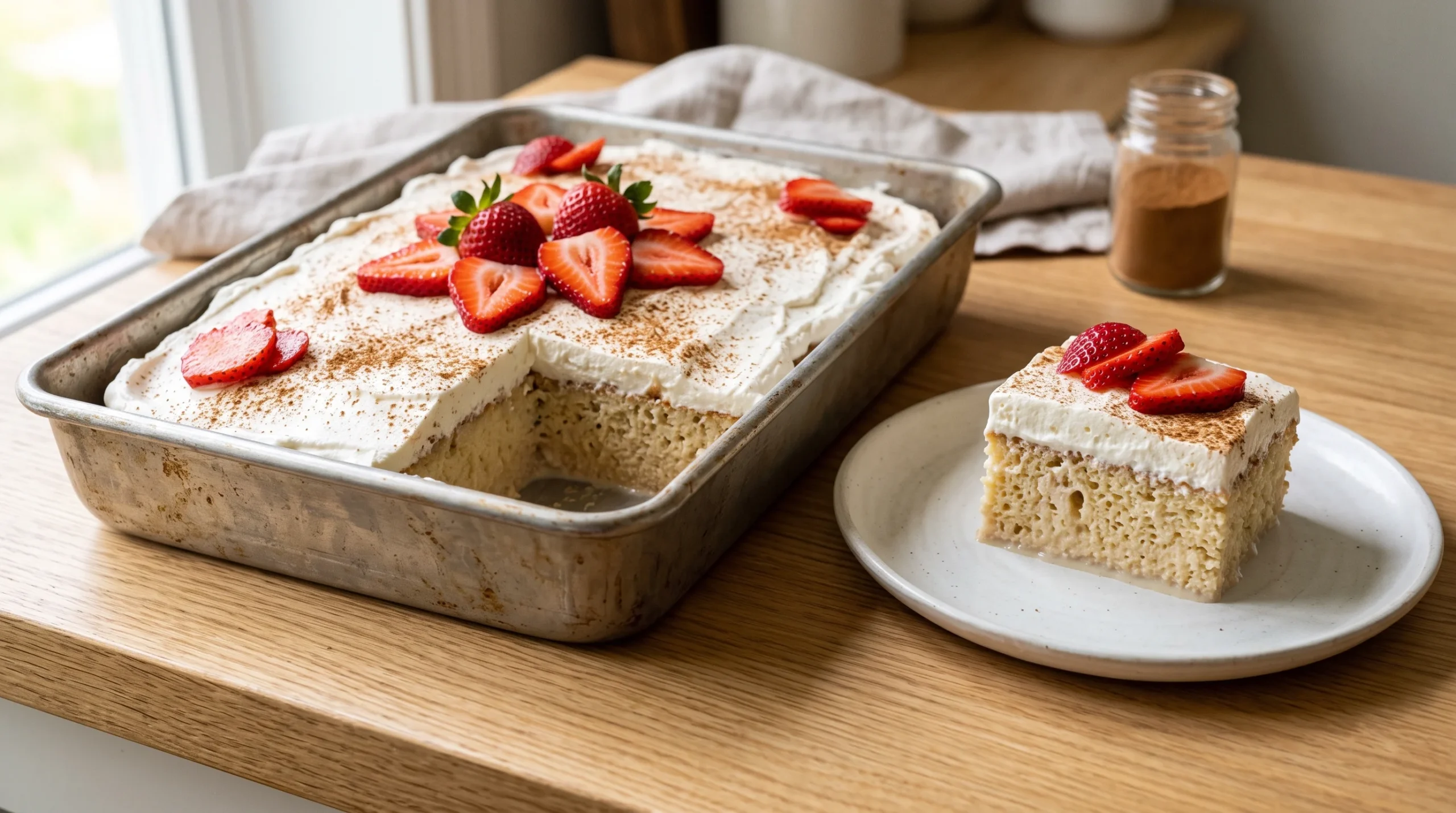
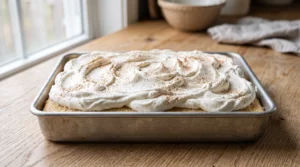
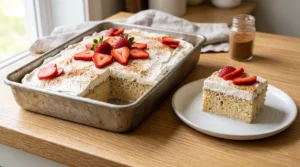
Before serving, whip the cold heavy cream, powdered sugar, and vanilla to soft peaks. Spread evenly over the top of the chilled cake using an offset spatula. Dust generously with ground cinnamon. Add fresh strawberries or cherries if desired. Serve cold, directly from the pan.
The Science: Why Tres Leches Cake Absorbs Without Becoming Soggy
This is the question every first-time baker has when they hear the concept, and the answer is genuinely interesting.
The sponge in a traditional tres leches cake is deliberately open and airy. No butter, no oil. The structure comes almost entirely from whipped egg whites, which create a foam of millions of tiny air bubbles held in a network of egg protein. When baked, this foam sets into a crumb that is porous and lightweight, with significantly more open space between the protein strands than a butter-based cake would have. This is the same structural principle behind angel food cake.
When the three-milk mixture is poured over the warm, poked cake, osmosis begins. Liquid moves from the area of high concentration (the milk soak on top) into the lower-concentration air pockets inside the warm crumb, filling them progressively as the cake cools and then chills. Because the crumb structure is so open, it can absorb a very large volume of liquid relative to its own weight without losing structural integrity, which is why this dessert feels saturated but not disintegrated.
Each of the three milks contributes something distinct. Sweetened condensed milk provides sugar, fat, and viscosity. It is the thickest of the three and gives the soak its sweetness and body. Evaporated milk is unsweetened and less thick, providing liquid volume and a concentrated dairy flavor without additional sugar. Heavy cream adds fat content and richness, and because fat slows liquid absorption slightly, it helps the soak distribute more slowly and evenly through the crumb rather than pooling at the bottom.
According to Serious Eats’ food science research on dairy in baking the protein and fat content of dairy products significantly affect how they interact with baked goods at a structural level. In a tres leches cake, using all three together is not tradition for tradition’s sake. Each component is doing something the others cannot.
The warm poking step is also structural. Warm cake is more pliable than cold cake, and the holes created while it is still warm remain open as it cools. Poking a cold cake closes the holes partially as the crumb contracts.
Tips That Make a Difference
- Separate the eggs while cold (cold yolks hold their shape better and are less likely to break), but bring them to room temperature before beating. Cold egg whites do not whip to full volume.
- Use a clean, completely dry bowl and beaters for the egg whites. Even a trace of fat (from egg yolk or residual grease) will prevent the whites from reaching stiff peaks.
- Pour the milk soak slowly. Dumping it all at once causes uneven absorption. A slow, steady pour from one end to the other gives the sponge time to absorb evenly.
- Overnight refrigeration is not optional if you want the best result. The 4-hour minimum gives you a technically acceptable cake. The overnight version gives you the real thing.
- Add the whipped cream topping and garnish just before serving, not the night before. Whipped cream weeps and loses volume when it sits too long on a cold, wet surface.
Variations
Strawberry Tres Leches Cake
Add a layer of sliced fresh strawberries between the milk-soaked cake and the whipped cream topping. The bright tartness of the strawberry against the sweet, cold, milky cake is one of the most popular variations across the American Southwest.
Horchata Tres Leches Cake
Replace the evaporated milk in the soak with an equal amount of horchata (the cinnamon rice milk drink). This adds a warm cinnamon and rice note to the soak that deepens the spice character of the finished cake significantly.
Chocolate Tres Leches Cake
Add 3 tablespoons of Dutch-process cocoa powder to the flour mixture in the sponge. Replace the heavy cream in the soak with chocolate milk. Top with cocoa-dusted whipped cream and chocolate shavings.
Coconut Tres Leches Cake
Replace the heavy cream in the soak with full-fat coconut cream. Add a handful of toasted shredded coconut to the whipped cream topping. This version bridges the classic Latin American tradition with tropical flavors that work beautifully year-round.
Cafe de Olla Tres Leches Cake
Brew a strong cup of Mexican cinnamon coffee (cafe de olla) and add 2 tablespoons to the milk soak mixture alongside the condensed and evaporated milks. The coffee and cinnamon deepen the flavor of the soak without making it taste like a coffee cake.
Serving Ideas
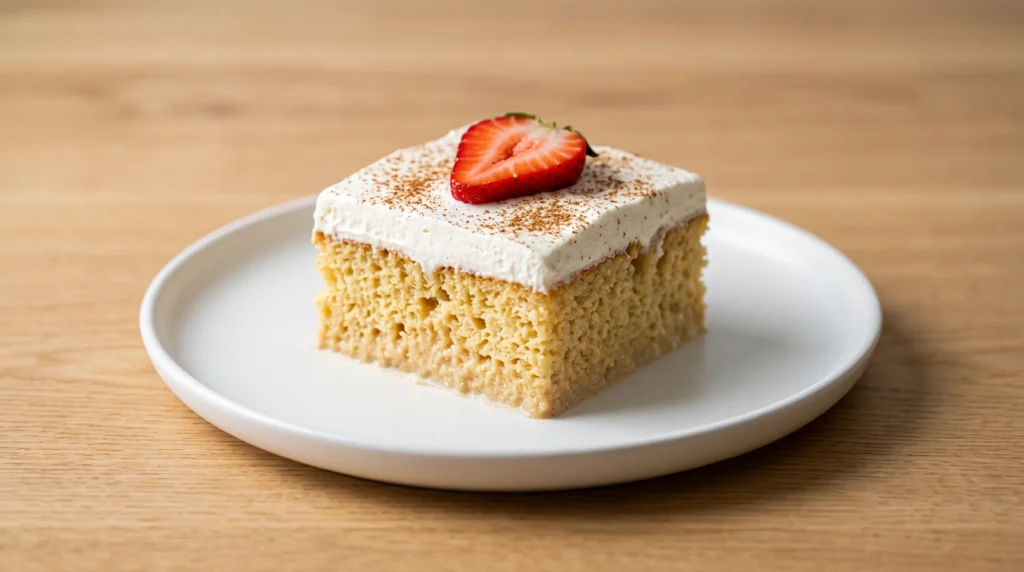
Tres leches cake is served cold and directly from the pan, which is part of its practical charm. No slicing and transferring required. Cut into squares, lift with a wide spatula, and place on plates. The cold, milky texture pairs best with nothing at all or with a simple dusting of cinnamon on each slice.
For a more festive presentation, arrange halved fresh strawberries across the whipped cream in a neat pattern before dusting with cinnamon. For Cinco de Mayo celebrations or Mexican-themed dinners, serve alongside a pitcher of horchata or a light citrus agua fresca. The sweetness of the cake and the refreshing lightness of the drink balance each other perfectly.
For birthday celebrations, piping the whipped cream in rosettes and adding a few sprinkles gives the cake a more formal appearance while maintaining the no-fuss, one-pan format that makes this dessert so practical.
How to Store Tres Leches Cake
Refrigerator: This is the only appropriate storage for tres leches cake. Cover tightly with plastic wrap and refrigerate for up to 4 days. The flavors and texture actually continue to improve through day 2 and hold well through day 3. By day 4, the whipped cream topping will have softened considerably but the cake itself remains good.
Freezer: Freeze the milk-soaked cake (without the whipped cream topping) tightly wrapped in plastic wrap and foil for up to 2 months. Thaw overnight in the refrigerator. Add the whipped cream topping fresh just before serving.
At events: Do not leave the cake at room temperature for more than 2 hours. Because of the high dairy content, food safety guidelines recommend keeping it refrigerated until serving.
A Personal Note
The first time I served this at a dinner party, I genuinely worried it had not worked. The cake looked small and slightly sunken in the pan. The milk soak had mostly absorbed but there was still a little pooling at the edges. It looked like something had gone slightly wrong.
Then I cut into it. The cold, creamy interior was nothing like what the outside suggested. The flavor was rich and milky and barely sweet and completely unlike any other cake I had ever made. By the time I served the last slice, two people had already asked for the recipe and one person had declared it the best dessert they had ever eaten at a dinner party.
That might be slightly hyperbolic. The cake is genuinely that good, though.
The Best Tres Leches Cake (Authentic, Moist, Make-Ahead)
Ingredients
Equipment
Method
- Preheat oven to 350 degrees F. Grease a 9×13-inch metal pan, line with parchment, and grease the parchment.
- Whisk together flour, baking powder, and salt. Set aside.
- Beat egg yolks with 3/4 cup sugar on high speed for 3 to 4 minutes until pale, thick, and doubled in volume. Add milk and vanilla. Whisk to combine. Fold in flour mixture with a spatula until just combined.
- In a clean bowl with clean beaters, beat egg whites on medium-high to soft peaks. Add remaining 1/4 cup sugar gradually and beat to stiff, glossy peaks.
- Fold egg whites into the batter in three additions. Stop as soon as no white streaks remain. Do not deflate.
- Spread batter into prepared pan. Bake 25 to 30 minutes until golden and a cake tester comes out clean.
- While still warm, poke holes all over the surface with a fork, spacing about half an inch apart.
- Whisk sweetened condensed milk, evaporated milk, heavy cream, and vanilla together. Pour slowly and evenly over the warm poked cake.
- Cover tightly with plastic wrap. Refrigerate at least 4 hours, ideally overnight.
- Before serving, whip cold heavy cream, powdered sugar, and vanilla to soft peaks. Spread evenly over the cake.
- Dust with cinnamon. Add strawberries or cherries if desired. Serve cold directly from the pan.
Notes
- Separate eggs while cold but bring to room temperature before beating.
- Use a completely clean, dry bowl for egg whites. Any fat prevents them from reaching stiff peaks.
- Pour the milk soak slowly for even absorption.
- Overnight refrigeration gives a noticeably better result than 4 hours.
- Add whipped cream topping just before serving, not the night before.
- Do not leave at room temperature for more than 2 hours due to high dairy content.
- Store refrigerated up to 4 days.
- Don’t rush the milk soak. If you pour it all in one place, the cake absorbs unevenly.
Frequently Asked Questions
What does tres leches mean?
Tres leches is Spanish for “three milks.” The name refers to the three dairy products used to soak the sponge cake: sweetened condensed milk, evaporated milk, and heavy cream (or whole milk in some versions).
Where did tres leches cake originate?
The exact origin is disputed among food historians, but the most widely accepted account traces it to Nicaragua and Mexico in the mid-twentieth century, where it is believed to have been influenced by recipe cards printed on cans of evaporated and condensed milk distributed by Nestle and Carnation throughout Latin America. It is now a beloved birthday cake tradition across Latin America and the American Southwest.
Can I make tres leches cake a day ahead?
Yes, and you should if possible. The cake needs at least 4 hours in the refrigerator to absorb the milk soak fully, and the flavor and texture are noticeably better after a full overnight rest. Add the whipped cream topping and garnish just before serving.
Why did my sponge cake shrink?
Shrinkage after baking is completely normal in a tres leches sponge and is expected. The cake shrinks as it cools because the air bubbles trapped by the whipped egg whites contract. Once you pour the milk soak over the cake, it absorbs the liquid and plumps back up to a normal size.
Can I use whole milk instead of heavy cream in the soak?
Yes. Traditional versions of this cake sometimes use whole milk as the third milk instead of heavy cream. The result will be slightly less rich and the soak will be slightly more liquid. For the richest, most satisfying result, heavy cream is the better choice.
Is tres leches cake served warm or cold?
Always cold. The milk soak and the whipped cream topping both require the cake to be chilled. Serving it at room temperature results in a texture that is too loose and a topping that begins to melt. Serve directly from the refrigerator.